
FEBRUARY 2026 RELEASE
Rachel Custer, MERCY
Monday Editions is delighted and honored to announce the publication of Rachel Custer’s third collection, Mercy, the quasi-narrative, quasi-lyrical poetic chronicle of what happens when two semirural Indiana women, Naomi and Ruth, set up a Little Free Library in front of their trailer at Kozy Park Estates (“Call a thing an estate, and you can pretend it’s livable, can charge an extra hundred bucks for rent”).
After some preliminaries, including a moving introductory essay, the collection proper opens on a grayscale map of northeastern Indiana, where the fictional town of Mercy is marked with a red star—the only spot of color in the book and, metaphorically speaking, one of few in the poems and the lives of their speakers.
On the two facing pages that follow, we find ten couplets and a monostich in Ruth’s voice (page 2), and a deft Elizabethan sonnet in Naomi’s (page 3). Ruth: “Most of our neighbors / borrow furtively, when night has fully darkened // our lightless street.” Naomi: “At first, the neighbors slunk around like strays, / as if afraid to come into our yard.”
And with that formal prologue—the reader’s introduction to “those two women,” as they’re referred to by the speaker of “The Next-Door Neighbor Borrows Crime and Punishment”—Mercy becomes a book of intensely voice-driven prose poems. As such, it uses every resource available to poetry except the line break.
In several of the poems, the reader hears the ghost of other sonnets. Sometimes it’s a Marleyesque ghost, loudly rattling its chains. Did Custer simply dust off some old sonnets, lose the line breaks, and upcycle little boxes of lineated poetry into little blocks of melodic prose?
Maybe. And what if she did? Is that a failing?
We say no.
For one thing, this is precisely the kind of strategy (among others, such as writing in syllabics) that a wily contemporary poet with a formalist temperament would use to sidestep both the lingering stench of reactionary New Formalism and the flabby orthodoxy of free verse.
For another, Custer’s prose poems work. As poems, they have music, compression, and striking imagery, the latter often embedded in a speaker’s regional idioms and figures of speech, which do double duty as narrative engines. As little monologues, they move elegantly through their linear or circular or recursive arcs, with not a word wasted, and without recourse to the facile surrealism that stands in for story logic in so much anglophone prose poetry.
In short, a poet who can write “Bombs shaped like children kept falling all around me” (“A Mother Reads The Lion, the Witch, and the Wardrobe”) and “Johnny is so often the thing disasters have in common, even when he doesn’t try to be” (“Johnny Reads The Adventures of Huckleberry Finn”) and “Gary’s a whole theater of a man” (“The Night Johnny Cash Drove Through Town”) and “I loved that baby a lifetime in three days” (“The Gravestone Washer Clips Obituaries from the Times”) has nothing she needs to justify or explain to anybody, anywhere, at any time. At all.
Like all books of excellence, Mercy flings open a world that edifies and challenges and changes its readers. In these linked poems, two women live together in mythical Mercy, Indiana, a tiny “finger wag of a town.” We come to know Mercy’s residents—factory workers, clergymen, farmers, and a host of others battered by poverty, addiction, and despair—through the books they borrow from the two women’s Little Free Library. This is a beautiful book, musical and full of surprising turns of phrase that will “stick inside you like a hook,” proving that “what makes a story true is how it’s told.”
—Francesca Bell, author of Bright Stain and What Small Sound
Rachel Custer had me weeping with her introduction to Mercy, and I kept weeping as I read the poems. Only rarely has a book caused me so much grief and joy at the same time. Custer writes of books that “get in your blood” and “alter you.” I can say that her poems have altered me. I was also a poor kid who depended on the bookmobile. The bookmobile was the most dependable thing in my life. I believe the same was true for Custer.
—Sherman Alexie, author of The Absolutely True Diary of a Part-Time Indian (National Book Award, 2007), War Dances (PEN/Faulkner Award for Fiction, 2010), and ten collections of poetry
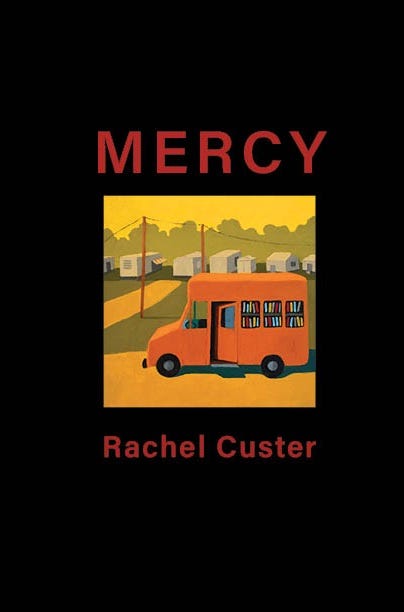
Rachel Custer, Mercy (Monday Editions, 2026). Limited edition, signed and numbered by the author. 5.5 x 8.5 inches, 46 pages. ISBN: 979-8-9926804-6-1.Publication date: February 25, 2026. Price: $22 (includes shipping within the continental US).
Rachel Custer is the author of two previous collections, The Temple She Became (Five Oaks Press, 2017) and Flatback Sally Country (Terrapin Books, 2023). Her work has appeared in many literary journals, including Rattle, The American Journal of Poetry, and Hobart, and she publishes Songs on the Way to God on Substack. A 2019 recipient of a National Endowment for the Arts fellowship in poetry, she lives in Indiana with her companion and their daughter.
Waning Gibbous IV, executive editor at Monday Editions, attended the Johns Hopkins Writing Seminars and completed the Columbia (formerly Radcliffe) Publishing Course. His late grandfather, Waning Gibbous Jr., is remembered as the author of two well-received collections, The Vicar’s Boneyard (1947) and O Lenticular Cloud of Sorrow (1958).